
Neurofeedback
- Home
- Neurofeedback
★★★★★ Rated 5 stars on Google · Drug-free & non-invasive · Licensed clinicians — not just equipment operators · St. Charles, Missouri
Ready to See What Your Brain Has Been Trying to Tell You?
Start for $27 to book your qEEG brain map — a picture of the root cause, not another guess. Or talk it through with Brandi first, free.
“I brought neurofeedback to NATIVation because I saw firsthand what it can do. Healing reaches further when it tends to the whole person — mind, body, emotion, and spirit — the balance the Medicine Wheel has always taught.”
Brandi Sweet, LCSW, ACHT
Founder, NATIVation Counseling
Where you are
We know why you’re here.
You’ve tried everything. Therapy that helped — until it didn’t. Appointments that end the same way every time: another prescription, another dosage change, and nobody ever asking why.
You know what the side effects can do. You’ve watched someone you love fade into a shadow of themselves, and you refuse to accept that as the only option. But you can’t keep living like this either.
There has to be something that actually gets to the root of it. There is.
You’re not against getting help. You’re for getting answers.
That’s exactly what a brain map is: a look at the root cause, in color, on a screen — no prescription required.
The basics
What Is Neurofeedback?
Neurofeedback is exercise for your brain — gentle, non-invasive training that teaches your brain to run on steadier, healthier rhythms. Nothing enters your body; sensors simply listen while your brain learns, session by session, to regulate itself.
It’s backed by decades of research, and unlike medication, the change is one your brain learns to keep.
How We Practice
We practice functional neurofeedback.
Not all neurofeedback is the same. Traditional neurofeedback usually follows a set protocol — training one or two spots on the scalp to nudge a single brainwave up or down, chosen mainly from your symptoms. It can help, but it treats most brains about the same.
Functional neurofeedback starts with yours. We begin with a qEEG brain map that shows how your whole brain — and the networks linking it — are actually working. From there we build training specific to you: the regions that are dysregulated, the connections that are out of sync, the patterns underneath what you’re feeling. We re-map as we go, so change is something we can measure, not guess at. And because your brain doesn’t live in a vacuum, we factor in the whole picture — sleep, stress, health, and history.
It’s the functional, qEEG-guided model developed by Dr. Richard Soutar, a longtime leader in the field: brain training grounded in your own data instead of a one-size-fits-all protocol. Which is exactly how we like to work — rooted in the whole person, never off a template.
The difference in a sentence: traditional neurofeedback trains to a protocol; functional neurofeedback trains to your brain.
What Is a qEEG?
qEEG stands for quantitative electroencephalogram — a detailed map of your brain’s electrical activity. It shows where your patterns run too fast, too slow, or out of sync, so your training can be built around your brain, not a generic template.
The Map
A qEEG Brain Map
Every neurofeedback program starts here — but a qEEG is not neurofeedback. It’s the map that makes neurofeedback precise.
You wear a comfortable sensor cap while we record your brain’s electrical rhythms. Nothing goes in — the sensors only listen.
Your patterns are then compared against a normative database of brains your age, producing detailed color maps that show exactly where your brain is running too fast, too slow, or out of sync.
That map is what your entire training program is built on. Instead of a one-size-fits-all protocol, your clinician uses your qEEG to choose precisely which areas and which rhythms to train — and re-maps along the way so you can see the change, not just feel it.
No guesswork. A blueprint.
The Review
Your Brain Map Review
Once your map is ready, you’ll meet with us online to walk through the results together — what your brain’s patterns look like, what they help explain, and exactly which areas and rhythms training would target. Then we design your custom program around your brain.
No two brains are the same — so we don’t offer one-size-fits-all programs. Your map decides your plan.
The Training
The Training Itself
From there, the real work begins — and it’s surprisingly relaxing. You’ll sit comfortably while sensors read your brainwaves, and gentle feedback through sound or a screen rewards your brain each time it shifts toward a healthier pattern.
Each session runs about 20 to 30 minutes. Most people train two to five times a week, and we set that rhythm together based on your map and your goals.
There’s nothing you have to consciously do. Your brain does the learning — quietly, steadily, session by session — until the new patterns begin to hold on their own.
The evidence
Backed by Decades of Science
Neurofeedback isn’t new or experimental. Clinicians have used it for more than fifty years, and it’s grounded in the same brain science that guides modern mental-health care.
What makes it work here isn’t only the technology — it’s that every brain map is read and every session is guided by licensed mental-health professionals, not technicians.
In Office or At Home?
Same programs, same price, same support — choose the format that fits your life. Every journey starts with an in-person brain map at our St. Charles office.

In Our St. Charles Office
- Your clinician is right there with you, every session
- Nothing to set up — arrive, train, and go
- A calm, dedicated training space away from home distractions
- Ideal if you’re local to St. Charles or the St. Louis metro
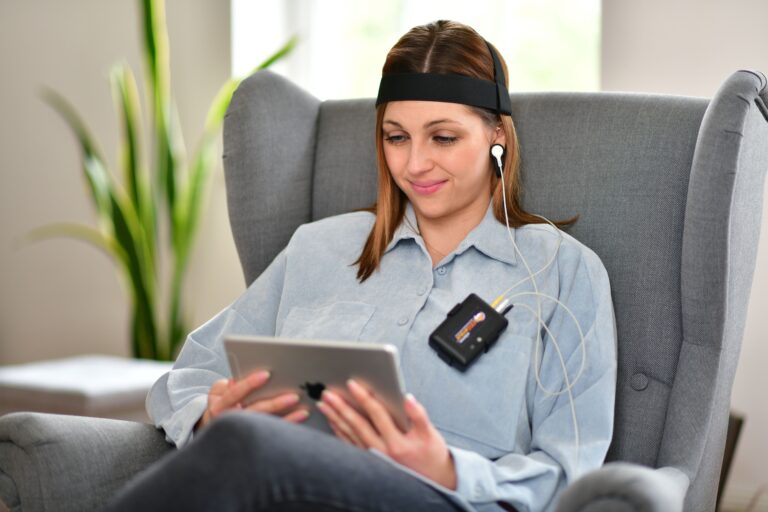
At Home
- Train 3–5 times per week — many families finish their program sooner
- No commute — kids train in their own space, on your schedule
- Remote support and progress monitoring from our team
- Requires a $700 refundable equipment deposit — returned when your kit comes home safe
Home kits are limited and subject to availability — ask about current availability at your Brain Map Review.
What it helps
How Neurofeedback Can Help
Discover how neurofeedback can support healing for a variety of conditions—naturally, gently, and without having to revisit painful memories.
ADHD & ADD
ADHD can make it hard to focus, stay organized, or manage impulses. Neurofeedback gently helps the brain find balance by teaching it to regulate its own activity.
Panic & Anxiety
Panic and anxiety keep the body braced for danger that never comes. Neurofeedback helps calm the brain’s alarm system so you can feel safe and steady again.
Depression
Depression can drain energy, motivation, and hope. Neurofeedback encourages the brain patterns linked with engagement and lift, gently supporting your way back.
Autism Spectrum
Autistic brains can get stuck in overwhelm and sensory overload. Neurofeedback supports calmer regulation — helping with meltdowns, sleep, and daily transitions.
PTSD & Trauma
Trauma can keep the brain and body locked in survival mode. Neurofeedback helps retrain the stress response, restoring a sense of calm, safety, and control.
Bipolar Disorder
Bipolar rhythms swing hard — racing energy, then crashing lows. Alongside your psychiatric care, neurofeedback trains the brain toward steadier ground.
Memory & Attention
When focus drifts, names and details start to slip. Neurofeedback strengthens the rhythms behind attention and recall at any age.
Sleep & Insomnia
Racing thoughts and 3 a.m. wake-ups mean a brain that can’t downshift. Neurofeedback teaches your system to power down naturally — no medication required.
Migraines & Headaches
Frequent headaches often ride on an over-aroused nervous system. Neurofeedback trains toward a calmer baseline — a drug-free complement to your doctor’s care.
Emotional Overwhelm
Big feelings that hit like a wave — meltdowns, shutdowns, flooding. Neurofeedback strengthens the brain’s braking system so calm comes back sooner.
Not only for challenges
Athletes, professionals, and students also train with neurofeedback to sharpen focus, steady performance nerves, and think more clearly under pressure. A calmer, more regulated brain performs better everywhere — not just in the hard moments.
Our approach
More Than a Machine
Anyone can buy neurofeedback equipment. What you can’t buy is what surrounds ours:
Neurofeedback trains your brain from the bottom up; therapy works from the top down. A regulated brain makes therapy faster and deeper — and because we re-map along the way, you can see the change, not just feel it.
Here, your brain training and your therapy live under one roof — same team, one plan. It’s “and,” not “instead of.”
This integrated path is exactly what Dr. Bessel van der Kolk champions in The Body Keeps the Score — pairing talk therapy with body-based work like EMDR and neurofeedback to reach what words alone can’t.
- Licensed mental health clinicians read your brain map — not just equipment operators
- Therapy, hypnotherapy, and brain training under one roof — one team, one plan
- Progress you can see: re-maps mid-program and at completion
- Whole-person, culturally grounded care that honors all of you
Steps to Get Started

1. Consultation Call
We start with a free consultation call to understand what you’re facing and see whether neurofeedback is the right fit — for you or your family member. No pressure, just honest answers.

2. Your qEEG Brain Map
You wear a comfortable sensor cap while we record your brain’s electrical activity. It’s painless and non-invasive — about an hour, and nothing goes into your body.

3. Your Brain Map Review
Sit down with our founder, Brandi Sweet, LCSW, and see your brain’s patterns explained in plain language. You’re not committing to anything yet — you’re getting answers.

4. Choose Your Package
If neurofeedback is right for you, you choose the training package that fits your goals and your budget.

5. Start Training
Begin your sessions at home or in our St. Charles office — whichever fits your life best.

6. Ongoing Support
You meet with us for a support session each week as your brain learns, so you’re never doing this on your own.
Programs & Pricing
Two ways to begin: see your brain first with a $27 qEEG brain map, or enroll directly in a program — programs from $4,490, and every one includes your qEEG. Clear prices, financial agreements in writing, and CareCredit accepted.
Neurofeedback in St. Charles & St. Louis, Missouri
In-office brain mapping and training at 1060 Country Club Rd, Suite 101, St. Charles, MO 63303 — minutes from Historic Main Street, serving St. Charles, St. Peters, O’Fallon, Chesterfield, and the greater St. Louis area. Prefer home? After your in-office brain map, at-home training systems are available anywhere in Missouri — Utah coming soon. Visit our St. Charles office →
Our Approach
Healing that actually reaches the root.
Most people find us after years of talk therapy that helped them understand their patterns but never quite changed them. What’s different here isn’t willpower or another technique — it’s the combination: EMDR, neurofeedback, and hypnotherapy, woven together with Indigenous healing, aimed at the nervous system where change actually happens.
After thousands of sessions, here’s what we see again and again: people who felt stuck for years start to feel regulated, clearer, and more like themselves — often faster than they expected, and in a way they can see, not just feel.
Rooted in Indigenous wisdom. Led by Native clinicians. Open to everyone.
FAQs
Frequently Asked Questions
Yes. Neurofeedback is non-invasive — sensors only read your brain activity; nothing goes into your brain. It has been studied for decades and is considered safe for children, teens, and adults.
No — and you should never stop or change a medication without your prescriber. Neurofeedback works alongside medical care, not instead of it. Many clients train while on medication. As the brain becomes more regulated, some families choose to revisit dosages with their prescriber over time — but that decision always belongs to you and your doctor.
A qEEG records your brain’s electrical patterns for about an hour through a comfortable sensor cap. The result is a map showing how your brain is functioning — the patterns behind focus issues, anxiety, sleep problems, and more.
Most neurofeedback runs a fixed protocol — the same handful of settings, chosen mainly by symptom. We practice functional neurofeedback: we start with a qEEG brain map of how your whole brain is actually working, then train the specific regions and connections that are out of balance for you, adjusting as we re-map. It follows Dr. Richard Soutar’s qEEG-guided model — which is why your plan is built around your brain, not a template.
No. Your training is built from your own qEEG brain map, so it targets the areas and connections that are out of balance for you — not a fixed, one-size-fits-all setting. As your brain changes, we re-map and adjust the plan to match.
Most people train in programs of 30–68 sessions, depending on goals and what your brain map shows. We re-map at session 20 and at completion, so progress is measured — never guessed.
Neurofeedback is private pay — insurance doesn’t cover it. We keep pricing transparent, credit your full brain-map fee toward any program, and offer CareCredit monthly payment plans.
Neurofeedback complements care rather than replacing it. Many clients pair it with therapy, and any medication decisions always belong with your prescriber. At your Brain Map Review we’ll talk honestly about what fits your situation.
No. Training helps your brain communicate more efficiently — most people describe feeling calmer, clearer, and more resilient. It doesn’t change who you are, your interests, or your spark.
Every brain is different. Many families begin noticing changes within the first few weeks of consistent training — and because we re-map mid-program and at completion, you’ll see the progress objectively, not just feel it.
Like riding a bike, the brain tends to keep skills it has practiced. Most people complete their program without needing ongoing sessions; some choose an occasional tune-up down the road.
No — keep taking anything your physician prescribes. If your results ever make a medication change worth discussing, that conversation happens with your prescriber, never on our own.
Children, teens, and adults. The qEEG brain map happens in person at our St. Charles office; training then continues in office or from home anywhere in Missouri — Utah coming soon.
After your in-person brain map in St. Charles, you can complete your training program from home with one of our equipment kits — training 3–5 times per week with remote support and progress monitoring from our team. Program pricing is the same as in-office; at-home adds a $700 refundable equipment deposit, returned when your kit comes back. Kits are limited and subject to availability. Before any program begins, you’ll review a clear written financial agreement — no surprises.

Curious About Neurofeedback? Start Here.
Download our free guide to drug-free brain training — what neurofeedback is, how a qEEG brain map works, and what to expect on the path to feeling like yourself again.
Download the Free E-Book →